


A really special part of my week since January has been online Embodied Anatomy study with Amy Matthews. “I love the feet!” she said as we began the first of three classes on the bones and ligaments of the foot. “I do too“, I wanted to shout out at my ipad, “I really love learning about and somatising the feet too!”
When the subject of ‘flat feet’ comes up amongst experienced yoga practitioners and some quarters of the fitness world, there can be a lot of concern – paranoia even – suggesting ‘flat feet’ are pathological. Yet Amy Matthews says “The height of the arch is not an indicator of the health of the pattern in the foot. The flatness of the foot is not an indicator of the health of the pattern in the foot.”
The feet are a regular focus in my classes – we began the summer courses last week by re-visiting this theme. We tried lifting the big toes and pressing down with the other toes, then pressing down with the big toes and lifting the other toes. I suggested my students visualise the movement happening if the toes were not obliging – this can be a first step towards the movement actually happening. We also practised inverting and everting our feet and noticed how this might relate to pronation or supination in standing. I asked my students for feedback on the distribution of weight in the feet. One girl said she felt more weight to the outer edge of her right foot and to the inner edge of her left foot.
On the course with Amy, I’ve been learning to embody subtle distinctions. Amy points out that inversion is not the same as supination and eversion is not the same as pronation. The definition of inversion is the lifting of the inner edge of the foot. The definition of eversion is the lifting of the outer edge of the foot. In adduction of the foot around the vertical axis, the inner edge of the foot shortens and the outer edge lengthens. In abduction of the foot around the vertical axis, the inner edge of the foot lengthens and the outer edge of the foot shortens. Amy says that if we add extension and flexion to the equation, we get three dimensional movement that’s pronation and supination.
Here are the ‘equations’:
Adduction + inversion + flexion = supination.
Abduction + eversion + extension = pronation.
Going back to my class last week, we also practised fanning/spreading the toes, first catching the little toe, then grounding the toes and lifting the heel. Then we brought the heel back down, taking care that the talus bone was aligned nicely atop of the calcaneous (heel bone). We regularly use this technique in my classes to help with balancing and standing postures. In the exercise we think of the talus bone as the keystone of the arch of the foot – as shown in Eric Franklin’s picture below, where I’ve coloured the talus bone in orange.

The talus is the keystone of the arch. Picture from Dynamic Alignment Through Imagery by Eric Franklin (talus coloured by Amanda)
Here’s a video showing how to do the alignment exercise:
In aligning the foot, as shown in the video, the ‘twisted plane’ image can be helpful. In effect there’s a spiral action in the foot between the toes/front of the foot that’s parallel to the floor and the back of the foot (heel) that’s vertical to the floor.
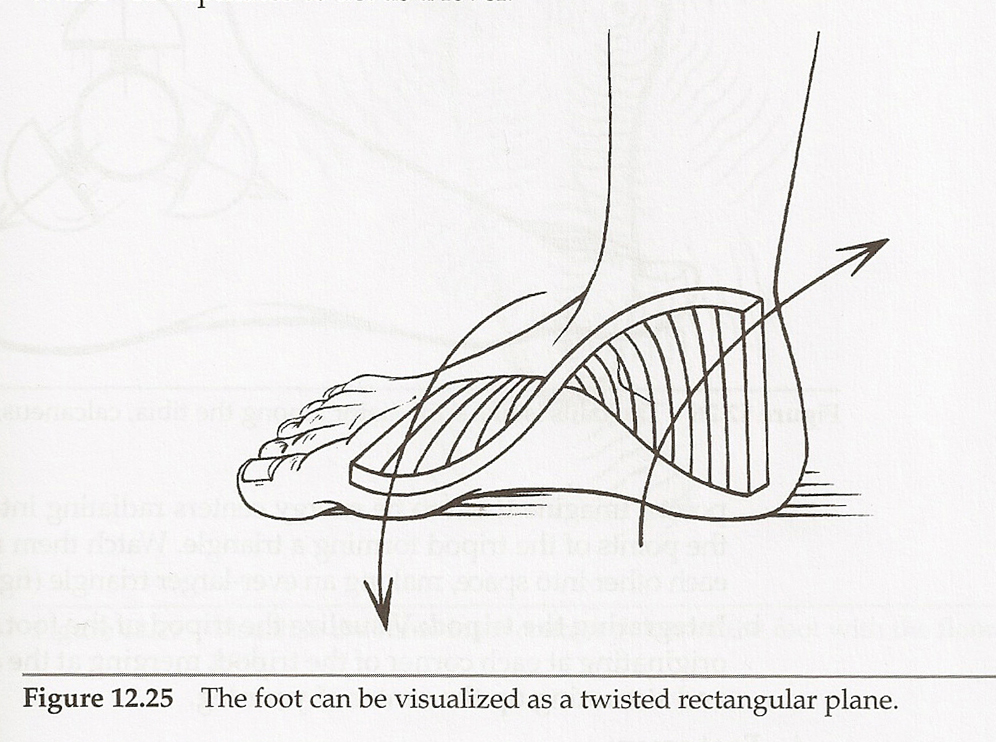
Image of the ‘twisted plane’. The front of the foot is parallel to the ground. The back of the foot (heel) is vertical to the ground.
Image from Dynamic Alignment Through Imagery by Eric Franklyn
In class, we’ve looked at the structure of the foot and marvelled at the feat of engineering that enables the talus bone to receive the weight of the body and distribute it down to the heel and forwards to the front of the foot and toes. If this was proposed as a brand new means to transport the weight of the human body, what would we think, I asked my students? “It could never work,” was the reply!


Pingback: Harrogate Yoga » How to have beautiful, healthy feet – banish bunions and other abominations!